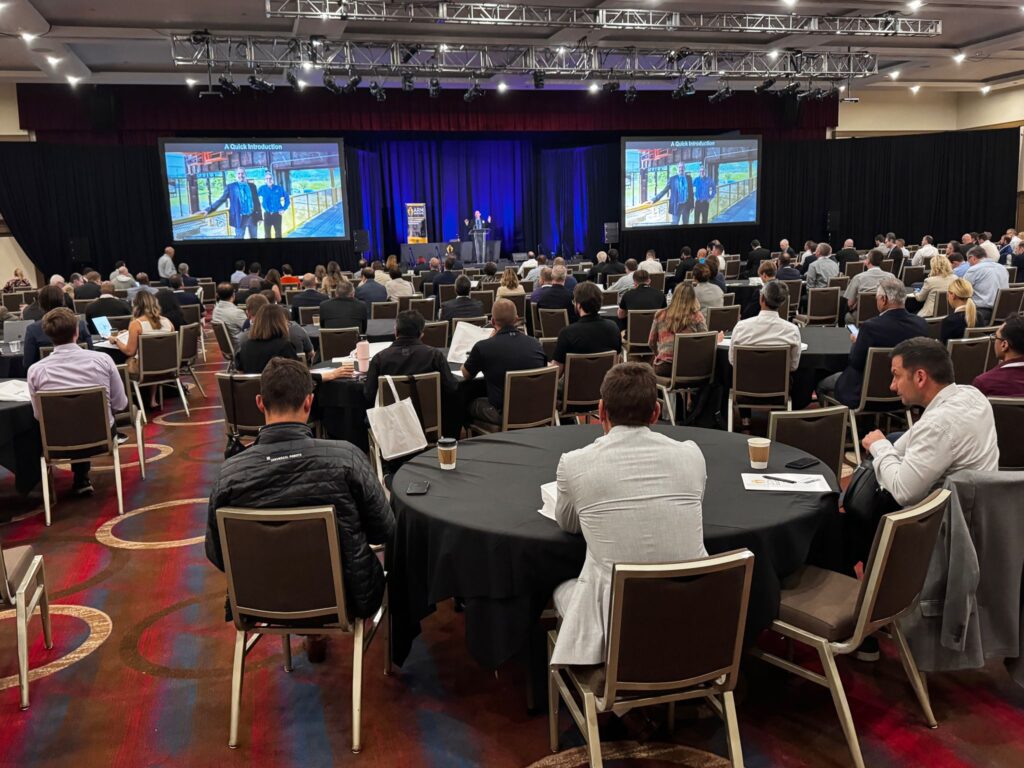
We’re just weeks away from our 10th Annual Member Meeting taking place Nov. 17-19 in Pittsburgh, PA! This member-exclusive conference is our largest event of the year, featuring 2.5 days of networking, collaboration, knowledge-sharing, a robust Member Showcase Hall displaying ground-breaking innovations, and more.
The five-minute pitch sessions are a member-favorite portion of our event. These sessions features experts from across our 500+ member organization consortium providing rapid fire presentations. These sessions are then followed by networking, enabling attendees to connect directly to the presenters for longer conversations.
Strictly timed, at precisely the five-minute marks the speakers are cut off and music is played, keeping our event moving and providing a good-natured competitive element to beat the clock. Members presenting a pitch can present about their organization at large, a problem they’re looking to solve with the help of the consortium, or a new product / offering. These presentations center on how robotics, physical AI, and workforce programs are transforming US manufacturing.
ARM Members apply for a pitch slot when registration opens. These immensely popular sessions fill rapidly with the ARM Institute selecting the pitches that have the broadest appeal and addressing the most impactful topics.
See who is presenting a five-minute pitch at our 10th Annual Member Meeting below:
Robots Built Your Way
HEBI Robotics
An off-the-shelf robot is not the best solution for every automation problem but building a robot is difficult and time-consuming. What if there was a way to start with a problem-first approach to robots and automation? HEBI Robotics explains the benefits of modularity when building robots to fit specific applications.
Delivering When the Science Gets Hard!
Data Science Automation
Data Science Automation is hired by customers when there is not an easy solution to the problem at hand. We create custom automation, sensor design, and advanced data analysis to make our end users more efficient. This overview will cover some of our SBIR outputs, our Automated Test Equipment, as well as customized measurement and end of line testers that we have produced in recent years. Government, Energy, Medical, and Electical testing solutions will be covered
Improving Execution in Complex Manufacturing Environments
Decision Flow
This discussion focuses on the gap between how manufacturers plan work and how execution actually unfolds on the floor. We’ll look at why traditional systems struggle to adapt once disruptions occur, and how that drives late deliveries, excess cost, and constant reprioritization. I’ll share an approach for improving real-time visibility into the true critical path and aligning teams around what matters most. Finally, we’ll highlight outcomes observed when execution is managed more dynamically.
Automated, Model-Based Production Planning
Dirac, Inc.
Dirac is a manufacturing software platform that automatically generates 3D assembly work instructions at scale, serving as the “how” layer that connects PLM (the what) to ERP (the when). Dirac turns engineering data into clear, step-by-step build instructions in a fraction of the time that manual authoring requires. This pitch will show how that capability accelerates new product introduction, absorbs engineering changes without bottlenecking the floor, and keeps work instructions in lockstep with evolving designs. We’ll demonstrate the impact across industries the ARM community cares about, including aerospace, defense, and industrial machinery. Attendees will leave understanding how automated work instruction creation enables the dynamic, agile American manufacturing that a resilient robotics and automation ecosystem depends on.
Integrated Automation Excellence for Complex Manufacturing Challenges
PMD
PMD is a privately owned, vertically integrated automation partner delivering custom machine building, system integration, and contract manufacturing from its 200,000+ sq. ft. headquarters in Victor, NY. With a deep bench of engineering, fabrication, and project management talent, the company provides end to end solutions from concept development through final assembly. PMD’s structured Automation Assessment process, advanced prototyping lab, and rigorous validation capabilities ensure every system meets the highest standards of quality, safety, and performance. The organization is fully equipped for defense and regulated markets, maintaining ITAR registration, NIST 800 171 compliance, and CMMC 2.0 readiness. Focused on long term partnerships, PMD consistently delivers on schedule, offering exceptional project execution, service, and support across diverse industries including aerospace, automotive, EV, life sciences, and semiconductors.
Fenceless Safety: Putting People and Heavy Robots Back to Work Together
Sensory Robotics
Sensory Robotics builds the SR-1, a certified safety system that uses 3D time of flight sensing to create virtual protective zones around industrial robots, letting people and heavy machines share the same floor without physical fencing. Unlike traditional guarding, the SR-1 removes payload, speed, and reach restrictions, so manufacturers recover floor space, raise uptime, and deploy collaborative cells that were previously impossible. The system carries full UL 1740 and PLd certification and is built to meet the 2025 revision of ISO 10218, giving safety engineers a defensible compliance path rather than a workaround. Early adopters include Toyota, Boeing, GM, and P&G, and a recent $1.25M Department of Defense grant is extending the platform to Air Force sustainment and depot applications. This five minute pitch will show ARM members across industry, government, and academia how fenceless safety changes the economics of automation and where it can be applied first.
Robot Raconteur: an Interoperable Middleware for Robotics
Wason Technology, LLC
Robot Raconteur is an advanced object-oriented middleware for robotics and automation applications. It is highly portable and available in many package managers. It has been supported and used by numerous ARM projects. The technology has undergone significant development over the last few years. This five minute pitch will present a brief overview of the technology and provide references for further reading.
Proven Adaptive Automation, What Comes Next
PAR Systems
Automating complex, high-value parts manufacturing is challenging when geometry, part presentation, and process conditions differ from the assumptions built into traditional automation. In this session, PAR Systems will share lessons from decades of fielded adaptive manufacturing and automation projects. These examples show how sensing, vision, and Physical AI can enable automated execution that responds to real-world variation—improving flexibility, consistency, and production performance while reducing dependence on rigid tooling and fixed programming. The session will also highlight SolidStir™, a solid-state Friction Stir Deposition technology for metal additive manufacturing, with potential applications for addressing casting and forging supply-chain challenges.
Defining the Role of the Robotics Technician
International Academy of Automation Engineering
The International Academy of Automation Engineering are working during Q3 2026 with three Life Science manufacturers, including J&J, to define a profile for the role of Robotics Technician. Mike Hourigan, Founder and President of IAAE would like to briefly share at the ARM National Meeting the high level output of this work that will define the key knowledge, sources of information and learning, as well as expected behaviours at several career stages for this role. The goal of doing so would be to benefit other members, bring awareness to the work by the IAAE and related ARM credentialed course, as well as seek interest in further improving the capability building of robotics technicians and specialists within the Life Sciences manufacturing community.
Training the Trainers: Scalable I4.0 Robotics & Automation Education
Lorain County Community College
Since 2021 Lorain County Community College’s Industry 4.0 Teacher Training program has trained and prepared educators to earn industry credentials and translate training into curriculum and classroom experiences for their students. Developed in partnership with the ARM Institute, the Ohio Manufacturers’ Association, IST Ohio, Rockwell Automation, and FANUC America, more than 50 secondary and post-secondary instructors have completed the program and gone on to teach automation and robotics skills and competencies. Leveraging LCCC’s equipment lending library as well as State of Ohio investments in training equipment, graduates have passed their training on to hundreds of students, pairing with pre-apprenticeship and other work-based learning models to meet a key talent need for manufacturers in Northeast Ohio and the state more broadly. Working with our partner K-12 and career-technical planning districts as well as local industry sector partners, instructors are teaching industrial robotics and PLC courses for high school dual-enrollment credit, creating an enrollment pipeline to LCCC’s certificate, associate, and applied baccalaureate programs in automation engineering technology. As we build systemic capacity and as demand for skilled technicians grows, Lorain County Community College and its partners have continued to enhance and iterate the program to offer more advanced trainings for instructors, integrating advanced programming, artificial intelligence, digital twin, and more.
Enhancing Safety in Collaborative Workspaces: Defining Attention and Avoidance Zones Using Path Planning with Mobile Robotic Systems
NIOSH
Ensuring the safety of human workers who work alongside mobile robots is extremely important. This study defines and delineates attention zones and avoidance zones for human workers to include both visual and audible aspects. Attention zones aims to keep workers aware of potential hazards. Specifically, visual attention zones focus on field of view and audible attention zones consider noise levels in the workspace. By establishing these zones, mobile robots can generate warning signals as human workers approach to minimize the risk of collisions. After determining optimal attention zones, researchers identify path planning strategies how they can be adjusted based on visual and audible warnings to avoid potential accidents. The proposed attention zone-based warning system and the contact avoidance zone represent a critical advancement in enhancing worker safety in collaborative workspaces to promote a safer workspace.
WSU Tech-NCAT, The Next Generation of Robotic Training
WSU Tech in Wichita, KS is expanding automation and robotics workforce innovation through its new robotics training center at the National Center for Aviation Training, creating one of the region’s most comprehensive hubs for robotics, automation, and advanced manufacturing training and education. The center provides hands-on robotics training pathways that begin with entry-level automation skills and progress into advanced industrial and collaborative robotic applications used across modern manufacturing environments. Students and incumbent workers will also gain experience in next-generation logistics and warehousing systems through training focused on autonomous mobile robotics and automated material handling technologies. Purpose-built laboratories will deliver immersive learning in smart manufacturing systems, Industrial Internet of Things (IIoT), industrial controls, PLC programming, and connected production environments that mirror today’s digital factories. By integrating robotics, automation, IT infrastructure, and operational technology into a full-stack IT-OT training ecosystem, WSU Tech is preparing the workforce needed to power the future of intelligent manufacturing and supply chain innovation.
Isn’t 3D Printing Just for Prototypes?
Tronix3D
“Isn’t 3D printing just for prototypes?” We hear it all the time. In five minutes, we’ll show how additive manufacturing has grown into a true production method, with engineering-grade polymers, titanium, and repeatable processes that deliver parts ready for the field, the factory floor, and the flight line
FLX BOT Solves the “Last Meter” of Inspection & Maintenance for the Navy, Air Force, & Beyond
FLX Solutions
FLX Solutions is modernizing maritime, defense, transit, and construction with the FLX BOT. It’s a miniature, modular, handheld collaborative robot that accesses hard-to-reach areas for inspection and maintenance. In Navy pilots, it reduced inspection times by up to 90% while eliminating teardowns and confined space entry. This talk will introduce the FLX BOT along with our ongoing work with the Air Force, Navy, and Dual Use programs (including those with ARM and ARM partners). It will discuss applications for both collaborative and autonomous systems for these use cases along with the “last meter” of inspection and AI which present large opportunities for improving fleet readiness and inspection quality and efficiency in general.
Autonomous Aerial Robotics for Coatings, Cleaning, and CBRN Decon
Apellix
Apellix builds software-controlled, human-in-the-loop autonomous aerial robots that apply industrial coatings, perform high-pressure cleaning, and conduct CBRN decontamination — removing workers from hazardous environments. Operators set the mission and supervise execution while the drones autonomously handle flight, positioning, and process control. Current Proofs of Concept include U.S. Army vehicle CBRN decon and Tier-1 industrial customers across the energy, maritime, and infrastructure sectors. We will share field-proven results in labor reduction, coating quality, and safety gains, as well as progress toward DLA qualification and naval modernization programs. The pitch closes with where Apellix is heading next — expanded CBRN decon capability, AI-driven inspection-to-action workflows, and partnership opportunities with ARM Institute members.
Physical AI is no longer confined to only the workcell: AI-Enabled Robotics for Mission-Critical Material Movement
Cobot
Manufacturers and government organizations face workforce headaches with retirements, call-offs, and lost expertise with increasing pressure to improve productivity, yet many automation solutions remain difficult to deploy, integrate, and scale in live operations and only live behind walls dependent on people to connect them to the process. Cobot addresses this challenge with AI-enabled autonomous mobile robots that automate material movement using existing infrastructure—without requiring software integration or facility modifications. Our flagship platform, Proxie, is already deployed in production environments across healthcare, logistics, and manufacturing, demonstrating that autonomous robotics can deliver measurable operational value today. What differentiates Cobot is our ability to transition robotics from research into sustained operational capability through in-house AI, modular system architecture, and deep expertise in fleet-scale deployments. Whether it’s answering: Where do I start, How do I scale, or Which technology is right for me, we believe the next challenge isn’t proving autonomous robots work—it’s deploying them at scale, and we look forward to discussing solutions with ARM Institute Members.
Foundational Control Systems for the Physical World
FederatedDesigns
FederatedDesigns combines our customers’ domain expertise with advanced software architecture practice and core tooling. We create the resilient Cyber-Physical Data Infrastructure required to power a next-generation Physical AI application. FederatedDesigns’ approach to robotics middleware and software development tools simplify development, integration, deployment, and iterative evolution. – Establish a unified Shared Operational State across distributed systems – Essential tools for seamless control and orchestration Together, these capabilities form an operational trust layer advantage for autonomous action, performance, and commercial success.
GE Aerospace
Stay tuned for more information about this pitch!
Industrial Metaverse: Beyond the Hype, the Next Step Towards More Performant and Sustainable Manufacturing
Siemens
Digital twin and digital thread are the foundation of the Industrial Metaverse. They already contribute to the design, manufacture, and operation of factories, buildings, transportation systems, smart cities in the most optimized way. The Industrial Metaverse will be the next step: a place for collaboration where immersive experience and real-time interactions will transform our economies and industries. We will be able to innovate and produce faster, increase the safety and quality of our production sites, while becoming more performant and more sustainable.
Physical AI in Automotive Assembly
Magna
Physical AI and humanoid technologies have the potential to unlock new set of automotive automation opportunities, specifically in the areas of human centric tasks such as dexterous manipulation and assembly of powertrain components and wire harnesses. The pitch will highlight a landscape of these opportunities presenting a structured technical roadmap for AI and humanoid developers. The use cases transcend automotive sector, and also represent growth opportunities at several DoD branches.
Targeted Data Collection to Improve Physical AI Operations & Training
Momentedge
Physical AI is making multimodal sensor data — cameras, LiDAR, IMU, machine state, autonomy logs — the foundation of successful autonomous systems. The companies that capture and learn from this data efficiently are the ones moving fastest. But every robotics team operating AI-driven fleets faces the same problem: they collect too much raw data they can’t use, miss the moments that actually matter, and spend engineering time finding those moments manually or building internal data infrastructure that should be spent on autonomy. Momentedge offers an open-source data recorder and configurations and processing tools for autonomous systems. Our differentiator is architectural: we fix the logic at the source, not in the cloud. The recorder runs on the physical AI node, filters noise at the edge using configurable logic, and captures clean, synchronized multimodal data only when it matters. Teams reduce storage costs, engineering time on data plumbing, and incident investigation time in tangible rates.
Overview AI: The AI Vision System Manufacturers Trust
Overview AI
Overview AI is an industrial AI vision company. We help advanced manufacturers catch the defects traditional machine vision cannot see: low contrast, reflective parts, soft-seated connectors. We have installed more than 2,000 cameras for customers like Toyota, Skydio, 3M, and SpaceX. Engineers choose us for 4 reasons. On-device NVIDIA training, so you train on the camera in minutes. A browser-native setup, so there is no dedicated PC on the line. Fully open automation through Node-RED and APIs, so it drops into your existing controls. And a data-first design, so every camera improves on real production data. The results speak for themselves. Customers report full fault detection in 30 minutes and a +90% cut in manual inspection time. This is because we removed the biggest bottleneck in deployment. Our new Gen AI tools synthetically generate every possible defect scenario for every SKU you plan to run, on day one. That means no waiting to collect failures and no retraining the cameras as you scale.
Synthetic Data for Robotics: From Defense-Grade Infrastructure to the Factory Floor
Zuru Automation
Robotics perception systems fail in production not because the algorithms are wrong, but because the training data doesn’t exist — collecting real-world labeled data at scale is slow, expensive, and often impossible in live industrial environments. Zuru Automation builds synthetic data generation and digital twin infrastructure that enables physical AI systems to train on photorealistic, physics-accurate simulated environments rather than waiting for real-world data collection. In a validated industrial deployment, Zuru’s infrastructure enabled a robotic perception system to identify over 1,000 unique SKUs in an automotive remanufacturing environment, reaching TRL-7 without a traditional data collection pipeline. The same infrastructure architecture — built to defense-grade standards for reliability and domain adaptability — is directly applicable to any manufacturing environment where robots must perceive, classify, or interact with variable physical objects. This pitch will give ARM members a concrete framework for evaluating where synthetic data infrastructure fits in their robotics roadmap, and what a deployment looks like from day one.
Applications of Machine Tool Robots for Steel and Aluminum Metal Cutting
Achieve Technologies Inc
Overview of the innovations in end of arm milling/drilling/tapping production tooling. Recent improvements in robotic sensors and encoders that enable improved rigidity and accuracy. Applications for reducing capx spend while increasing productivity. MTR as the subtractive side of robotic hybrid manufacturing cells. Plus more!
Attend Our 2026 Member Meeting
Ready to connect with these experts and others at our event?
ARM Members can register by logging into the Member Community or emailing us at [email protected].
Not a member? Join our consortium to gain access to our 10th Annual Member Meeting and other member-exclusive benefits, including access to project funding and our digital Member Community.
Learn more about the ARM Institute Annual Member Meeting
ABOUT THE ARM INSTITUTE
The ARM (Advanced Robotics for Manufacturing) Institute is a Manufacturing Innovation Institute (MII) funded by the Office of the Secretary of War under Agreement Number W911NF-17-3-0004 and is part of the Manufacturing USA® network. The ARM Institute leverages a world class consortium of 500+ member organizations and partners across industry, academia, and government to assert the US as the leading nation in manufacturing output through the adoption of robotics and AI. Based in Pittsburgh, PA since 2017, the ARM Institute has a dual focus on catalyzing innovative yet practical robotics and physical AI solutions while growing and preparing the US workforce for advanced manufacturing careers.
For more information, visit www.arminstitute.org and follow the ARM Institute on LinkedIn