
Virtual Part Repair Programming Project Team
University of Connecticut, Titan Robotics
Virtual Part Repair Programming Background
This Project was funded through a Directed ARM Institute Project Call by The Air Force Research Lab (AFRL) Manufacturing and Industrial Technology Division (ManTech). Directed ARM Institute Project Calls strengthen collaboration between ARM Institute Members and government entities like the Department of Air Force.
This Directed Project Call aimed to quickly advance solutions for the Department of the Air Force. Current methods for thermal spraying are repetitive and time-consuming. Repairs for each part also vary greatly and, thus, each individual part requires custom programming to identify where the robot needs to apply a thermal coating. The goal of this robotics project is to standardize the coating process in order to accurately and consistently repair parts.
AFRL and the ARM Institute were able to execute rapid mobilization and contracting to award funding within only four (4) months of notification.
Virtual Part Repair Programming Approach
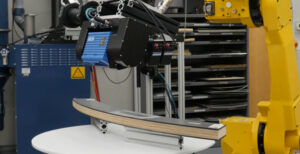
This project has developed a virtual method for operators to automatically generate a robotic thermal spray path plan over a repair area on a physical part within a thermal spray booth using an immersive interface, making robotic thermal spray applications faster and more efficient than previously possible.
The project team at UConn has designed and developed a sensor system for measuring thickness buildup over a part during various thermal spray processes. The sensory measurement will be paired with a virtual repair programming interface from Titan Robotics where the operator will simply highlight (i.e. virtual mask) the repair in the graphical user interface (GUI) and build up the thermal spray coating to a desired thickness over the selected part area for repair. All work (part localization and repair area selection) performed by the operation takes place in an augmented reality environment thru the use of Microsoft HoloLens.
Virtual Part Repair Programming Impact for the Department of War (DoW)
This new system will limit the human operators’ exposure to the dangerous thermal spray operation, preventing the injuries and strain caused by repetitive operations during post-processing tasks. It also does not require the operator to be familiar with robotic programming. With little-to-no training, the operator will be able to successfully perform a robotic thermal spray repair without ever handling a teach pendant or programming a complex robot path plan. This project substantially advances the capability of standard robotic systems by integrating advanced sensing and robot path planning capabilities.