Project Team:
CapSen Robotics (Principal Investigator), The Ohio State University (OSU), Southwest Research Institute (SwRI), and Yaskawa
Background: The Use of Robotics is Critical to Securing the $110+B Metal Casting Industry. What’s Preventing Adoption?
The metal casting industry is critical to US manufacturing and defense readiness, generating $110+ billion in economic output when combining the direct, indirect (supplier), and induced impacts (source). Castings are used in around 90% of all manufactured durable goods in the United States and nearly all manufacturing machinery (source).
However, despite the critical nature of the industry, workers in metal casting face some of the highest injury and illness rates across manufacturing due to high heat, airborne particulates, heavy lifting, and repetitive manual tasks. Workers are still taking on the dull, dirty, and dangerous tasks that should be offloaded to robotics and physical AI.
So why is critical industry still so reliant on manual labor?
Nearly 80% of all US foundries are small businesses with fewer than 100 employees (source). Small and medium-sized manufacturers can’t tolerate risk the way that larger manufacturers with full-fledged R&D departments can. One wrong investment can stagnate already thin profit margins and a workforce that’s not prepared to work with automation can result in a robot sitting unused in a corner. For a small manufacturer, failed automation projects are threats to their business rather than potential setbacks.
The ARM Institute’s Role: Funding Casting & Forging Projects to Secure US Manufacturing
The ARM Institute was created to get robotics, physical AI, and automation into the hands of manufacturers of all sizes and prepare the workforce for roles working with these technologies. Our funded projects, selected through ARM Institute Project Calls, bridge the gaps between industry, government, and academia to catalyze solutions that address critical areas of need.
Our automation services enable us to work directly with industry to objectively identify how robotics can (and in some cases, cannot) strengthen your manufacturing operations. We can then de-risk customized solutions in-house or bring these problems to our 500+ member organization consortium for ideation. In tandem, our workforce modernization services help manufacturers understand the current skills of their workforce and the training needed to ensure they’re ready for automated solutions.
This project highlight explores how an ARM Institute project team, funded through an ARM Institute Project Call, collaborated to advance the state-of-the-art in automating finishing processes in the metal casting industry.
Overview of Our Automated Finishing of Castings: Parting Line Grinding Project
The ARM Institute has funded several projects, leveraging funding from the Department of War, to spur robotic and physical AI solutions for the casting and forging industry. One project team, led by CapSen Robotics with The Ohio State University (OSU), Southwest Research Institute (SwRI), and Yaskawa, worked to address parting line grinding.
Metal casting offers considerable flexibility in a component’s size, shape, and material and is often used the low volume, high mix manufacturing. Castings often have highly variable features and defects that need to be removed or post-processed. The needed finishing processes, including grinding, grit blasting, and weld repair, are typically completed manually. Automating these processes has been identified as one of the most impactful caopportunities for time/cost reduction and quality improvement in the casting industry.
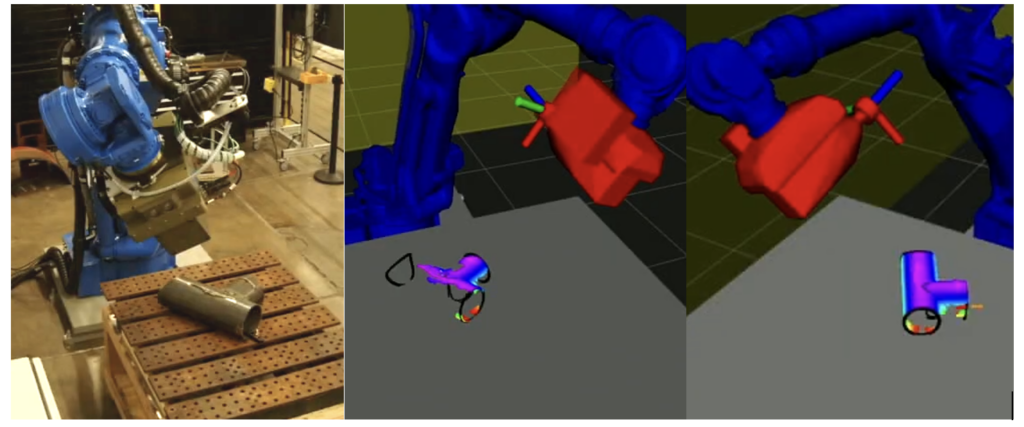
CapSen Robotics, partnered with OSU, SwRI, and Yaskawa, to develop a robotic finishing cell that autonomously grinds parting line flash on complex objects. The system images the cast component, reconstructs a 3D model of the part, identifies parting line flash, creates a tool path and motion plan for performing the griding operation, and executes robotic griding – all without or with limited human intervention and no explicit CNC programming.
Impact of Our Automated Finishing of Castings: Parting Line Grinding Project
The project was successfully demonstrated, leveraging two relevant geometries, an I-beam and a T-pipe. Weld beads were put down repeatedly and ground down on the same parts to simulate representative material to be ground off. The robot successfully executed the scan, plan, and grind sequence for both parts. The basic capability of grinding new parts with automatic vision and path planning was demonstrated successfully.
Beyond the metal casting industry, ARM Members who are invested in flexible manufacturing or quality control can benefit by leveraging software and methodologies for integrating and controlling multiple manufacturing processes in a quality-based closed-loop manner.
Get Hands-On with the Results: Project Outputs
ARM Members have access to the following project outputs or consortium-developed intellectual property (CDIP) on the ARM Member Community, as well as more detailed reports and videos:
- CapSen PiC Plugin (library)
- Grinding Process Statistical Model
- System Top-Level Design / Architecture (PDF)
- All Physical Hardware Specs and Integration Docs
Not an ARM Member? Join our consortium to gain access to the outputs from ARM Institute funded projects.
ABOUT THE ARM INSTITUTE
The ARM (Advanced Robotics for Manufacturing) Institute is a Manufacturing Innovation Institute (MII) funded by the Office of the Secretary of War under Agreement Number W911NF-17-3-0004 and is part of the Manufacturing USA® network. The ARM Institute leverages a unique and robust consortium of nearly 500 member organizations and partners across industry, academia, and government to make robotics, autonomy, and artificial intelligence more accessible to U.S. manufacturers large and small, train and empower the manufacturing workforce, strengthen our economy and global competitiveness, and elevate national security and resilience. Based in Pittsburgh, PA since 2017, the ARM Institute’s mission is to assert the US as the leading nation in manufacturing output through the adoption of robotics and AI. For more information, visit www.arminstitute.org and follow the ARM Institute on LinkedIn and X.