
ARM Institute Members vary in their focus areas, sizes, and history, but one common thread unites each organization: a drive to build the future of US manufacturing. Each of member organization leverages their strengths and areas of expertise to secure a brighter future for the US workforce, a stronger Organic Industrial Base (OIB), and a more resilient manufacturing economy. We bridge the gaps between industry, academia, and government to solve complex issues inhibiting the ability for the US to be a global leader in manufacturing output. To do this, we convene every stakeholder across manufacturing – from manufacturers themselves, technology providers, and defense suppliers to universities and community colleges, start-ups, and other types of organizations.
This month, our five questions interview features Parminder Jassal, CEO and Co-Founder of ARM Member and ARM Endorsed Training Program, Unmudl. In this interview, Parminder explores how Unmudl is building the technician level talent that will unlock US manufacturing potential, details why Unmudl applied for ARM Institute-Endorsement, outlines how you can collaborate with Unmudl, and more!
1. Can you tell us about your background and what compelled you to create Unmudl?
I’m CEO and Co-Founder of Unmudl®, a public benefit corporation founded with America’s community and technical colleges. We help people get the skills, credentials, and jobs they need for technician careers in an increasingly advanced and automated economy. My background spans the fiber optics industry, economic development, philanthropy, and futures research. I brought these experiences together to help create Unmudl’s Skills-to-Jobs® technician infrastructure that fuels the Technician Economy™.
The Technician Economy™ is an emerging and growing part of the U.S. economy where skilled technicians turn new ideas, technology, and investments into working systems, products, and services that keep modern industries running and competitive.
Throughout my career, I kept running into the same issue over and over: innovation only creates value when there is technical talent to deploy and sustain it. Engineers may design the systems, but technicians install, operate, maintain, troubleshoot, and keep them running. As technology and automation become more advanced, the gap between engineers and technicians keeps stretching. At some point, it became impossible for me to ignore.
I saw the same pattern show up everywhere I worked, including in regional economic development, national postsecondary strategy, and my work at the Institute for the Future. Employers had real demand, learners needed clear pathways, and regions lacked the coordination infrastructure to connect the two. That is the throughline in everything I’ve done: talent systems have to be connected to the way the economy actually operates, not float above it.
That became the foundation for Unmudl, launched in 2019 with America’s community and technical colleges. It also became the foundation for a larger shift we now call the Technician Economy™: the recognition that America’s innovation agenda depends on the technician workforce required to turn investment into operating capacity.
At the center of that work is what we have identified as the Innovation Deployment Gap: the space between investment in advanced technologies, facilities, automation, infrastructure, and equipment, and the technician capacity required to convert those investments into operating capacity. Technicians serve as the deployment layer that turns technology into productivity, equipment into capacity, and investment into economic value. Unmudl exists to help close this Innovation Deployment Gap by connecting employer technician demand to practical Skills-to-Jobs® skill paths with community and technical colleges.
2. Unmudl is an ARM Institute Endorsed training program, meaning you’re one of the top training programs for manufacturing careers in our nation. Can you tell us about your process in becoming Endorsed and any value you’ve found in being part of the program?
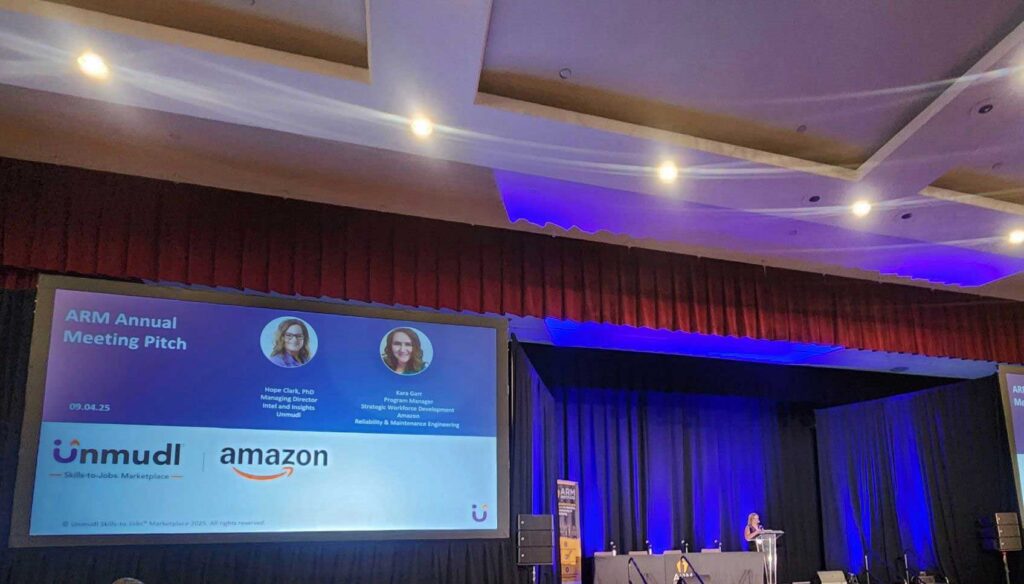
Becoming ARM Endorsed was especially meaningful because Unmudl had the honor of being the first employer-requested Skills-to-Jobs® program to receive the endorsement.
The process began with technician employer demand from Amanda Willard, Global Workforce Strategist at Amazon Reliability & Maintenance Engineering. She identified a need for locally available, flexible technician training aligned to the skills required in modern maintenance, automation, and mechatronics-driven environments. That employer request led to Unmudl’s ARM Endorsement review and a request by Kara Garr, Amazon RME Strategic Workforce Development Program Manager, to attend the ARM Institute’s Annual Meeting to showcase Amazon-Unmudl endorsed skill paths.
That matters because it reflects how Unmudl approaches technician workforce development. We start with the technician roles employers are trying to fill, identify the skills required to succeed in those roles, and connect those needs to practical training skill paths with community and technical colleges.
ARM Endorsement gave Amazon-Unmudl Skills-to-Jobs® mechatronics and controls programming external validation from an organization deeply respected in defense, advanced manufacturing, robotics, and automation. It also brought a manufacturing, robotics, and automation lens to the question of technician readiness.
The endorsement reinforced something we at Unmudl strongly believe: technician training should not be disconnected from industry need. It should be grounded in real demand and aligned to where advanced manufacturing is actually heading. Inspired by our work with Amazon, Atlas Copco requested ARM Endorsement of our Accelerated Air Compressor Technician skill path. We believe more employers will follow suit and request ARM Endorsed skill paths for other high-demand technician roles.
For us, ARM Endorsement is not just a stamp of approval. It is a signal that technician training must be rigorous, employer-aligned, and connected to the future of advanced manufacturing. It has also placed Unmudl within a national ecosystem of organizations working to modernize manufacturing talent pipelines and strengthen America’s advanced manufacturing workforce.
3. Unmudl is very focused on the technician role. Tell us why you consider technician roles to be the “backbone of America’s economy,” as you’ve noted on your Technicians of America website.
We are living through what we call the Innovation Deployment Gap: historic investment is flowing into advanced technologies, equipment, infrastructure, and facilities, but that investment only creates value when there is technical talent to deploy, operate, and sustain it. That is why technicians matter so much.
People love talking about the technology: advanced manufacturing, robotics, energy, aviation, semiconductors, AI data centers, logistics, and life sciences. But technology does not deploy itself or maintain itself. It does not troubleshoot itself in the middle of a production shift, repair an aircraft before departure, restore a power system, keep a data center running, or bring an advanced manufacturing line back online. Technicians do that work. They turn innovation into output. They stand at the point where investment becomes productivity, where equipment becomes capacity, and where ideas become real economic value.
That is why we call technicians the backbone of America’s economy. They are not in support roles. They are the hands-on infrastructure layer of the American workforce. If we want to lead in advanced manufacturing, robotics, AI, energy, aviation, semiconductors, and national competitiveness, then we must recognize, value, and build the technician workforce at the center of that future.
From my perspective, technicians are where America’s innovation agenda meets the real economy.
4. What should other ARM Members know about how they can collaborate with Unmudl?
Unmudl is intentionally focused on one of the most critical parts of the technical workforce market: technicians, the people who install, maintain, operate, repair, and sustain the systems that make modern industry work.
That focus matters because technicians are becoming central to whether innovation can actually scale. Advanced manufacturing, robotics, automation, energy systems, logistics, aviation, AI infrastructure, and modern industrial facilities all depend on skilled technicians who can install, operate, maintain, troubleshoot, and sustain complex systems.
We use the Technician Economy™ as a shared framework for this work. It identifies the economic shift already underway and helps employers, regions, colleges, and national partners organize around the same challenge: building the technician capacity required to turn innovation investment into operating capacity.
It also gives us shared language and a measurement framework so employers, colleges, and regions can stop seeing technician shortages as isolated pain points and start treating them as a coordinated capacity challenge.
Collaboration with Unmudl usually starts with a practical question: Which technician roles are most critical to your ability to grow, deploy, produce, and compete? From there, we work with employers and regional partners to better understand priority roles, skill needs, hiring gaps, and technician capacity.
That can include helping companies understand their Technician Portfolio Value™. TPV helps employers look at technician capacity as a strategic asset: the roles, skills, gaps, pipelines, and risks that affect operating performance. It can also include connecting roles to Skills-to-Jobs® pathways, engaging community and technical colleges, and participating in Regional Technician Roundtables™ alongside other employers and regional partners facing similar challenges.
The reason this collaboration matters is simple: no company can solve the technician shortage alone. The market has underinvested in the technician workforce infrastructure needed to support advanced manufacturing and modern industry. That underinvestment shows up as delayed deployment, unfilled roles, slower growth, and unrealized ROI on innovation investments.
So our invitation to ARM Members is this: work with us wherever technician capacity is becoming a constraint, whether in your company, your supply chain, or your region, and help convert that constraint into increased technician capacity. Together, we can make technician demand more visible, align training capacity to real industry need, measure progress more clearly, elevate technician careers nationally, and help more people move into durable, high-value roles.
If America wants innovation to scale, then we have to build the technician workforce together.
5. We’ve recently opened registration for our 10th Annual Member Meeting. 2025 was your first ARM Member Meeting with us. What value did you find from participating in our event?
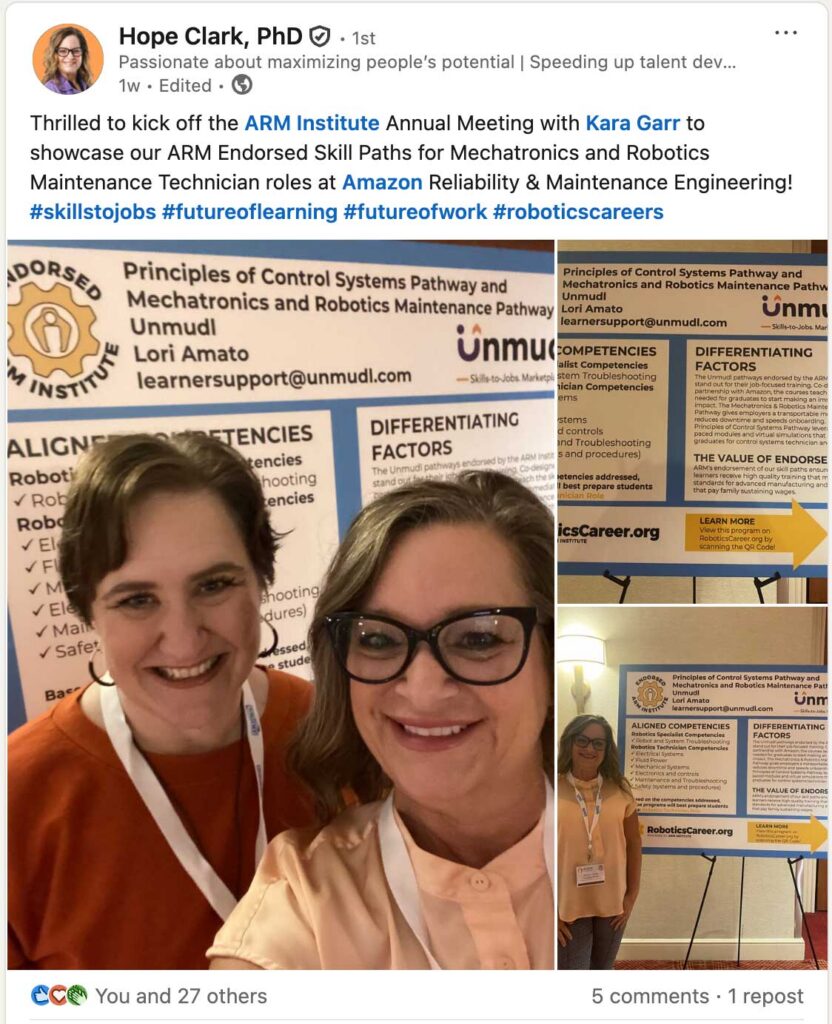
The 2025 ARM Member Meeting was valuable because it brought together the right mix of people: employers, educators, technology leaders, workforce partners, and national manufacturing stakeholders.
For Unmudl, the value was seeing how much alignment exists around the same core challenge. The technology is advancing quickly, but the workforce systems needed to support deployment are not always moving at the same speed.
The Member Meeting created a place to talk about the Innovation Deployment Gap in a practical way. It was not just a conversation about the future of robotics or advanced manufacturing. It was also a conversation about the people and skills needed to make that future real.
That is what makes the ARM Institute so important. The ARM Institute is one of the few places where the technology conversation and the workforce conversation can happen together. I also appreciated the quality of the ARM member consortium. These are organizations thinking seriously about competitiveness, automation, manufacturing productivity, and the workforce required to support all of it.
Participating in the ARM Institute’s Member Meeting reinforced for us at Unmudl that technician talent is not a peripheral issue. It is central to whether advanced manufacturing investments succeed.
6. Bonus Question: What’s new with Unmudl that you’d like the public to know about?
Unmudl is expanding from individual Skills-to-Jobs® pathways into a broader national focus on the Technician Economy™.
We are working with employers, community and technical colleges, chambers, economic development organizations, workforce partners, and industry groups to build and measure regional technician capacity.
That includes activating Regional Technician Roundtables™ in key regions, helping companies define their most urgent technician needs, and creating Skills-to-Jobs® skill paths that connect people to high-demand technician roles.
We are also elevating the public understanding of technician roles through platforms like TechnicianEconomy.org and TechniciansOfAmerica.com. These careers are not backup options. They are high-skill, high-demand technician roles that power manufacturing, aviation, energy, robotics, data centers, infrastructure, and much of the rest of the economy.
The next chapter is not just about training more people. It is about building the national and regional technician workforce infrastructure, in collaboration with organizations like the ARM Institute, required for America’s innovation investments to produce economic capacity for companies, technicians, and communities.
For me, the big message is this: America is investing heavily in advanced industries, but those investments only become real operating capacity when we have the technicians to build, run, and sustain them. That is the work ahead, and that is where Unmudl is focused.
Join Unmudl & Our 500 Member Organization Consortium in Building the Future of US Manufacturing
ARM Institute Members lead the way to a future where people and robots work together to respond to our nation’s greatest challenges and to develop and produce the world’s most desired products. By becoming a member of our 500+ member organization consortium, you’ll join thousands of subject matter experts in building the future of US manufacturing through robotics, physical AI, and workforce innovations. Your membership to our robotics institute unlocks not only access to member-exclusive events and webinars, including our Annual Member Meeting, but also project funding opportunities, project outputs, networking, a digital platform for collaboration, and more.
Join our consortium
2026 ARM Institute Member Meeting
Register today for our 10th Annual Member Meeting taking place Nov. 17-19 in Pittsburgh, PA. Our Annual Member Meeting convenes experts from across our consortium for three days of networking, knowledge-sharing, and collaboration. This event is open only to ARM Members. Join our consortium to gain access to this unique event.
Thank you to our Platinum Members: GE Vernova, Northrop Grumman, and Siemens, our 10th Anniversary Presenting Sponsors Corsha and the Italian Trade Agency, as well as our event sponsors AMT – The Association For Manufacturing Technology, fivestar*, GridRaster Inc., ReadyOne Industries, RPI’s Center for Smart Convergent Manufacturing Systems, Tronix3D, and Yaskawa Motoman for supporting our event!
Learn more & register
ABOUT THE ARM INSTITUTE
The ARM (Advanced Robotics for Manufacturing) Institute is a Manufacturing Innovation Institute (MII) funded by the Office of the Secretary of War under Agreement Number W911NF-17-3-0004 and is part of the Manufacturing USA® network. The ARM Institute leverages a unique and robust 500+ member organizations and partners across industry, academia, and government to make robotics, autonomy, and artificial intelligence more accessible to U.S. manufacturers large and small, train and empower the manufacturing workforce, strengthen our economy and global competitiveness, and elevate national security and resilience. Based in Pittsburgh, PA since 2017, the ARM Institute’s mission is to assert the US as the leading nation in manufacturing output through the adoption of robotics and AI. For more information, visit www.arminstitute.org and follow the ARM Institute on LinkedIn and X.