This ARM Institute funded project addressed a key-enabler to meeting demand and lowering manufacturing costs in the defense and commercial aerospace industries.
Project Team
Principal Investigator (Principal Investigator (PI)): RTX Technology Research Center
Project Team Members: Carnegie Mellon University, Wason Technology, Collins Aerospace
Background
Lightweight carbon fiber-reinforced thermoplastic composites (CF-TPCs) are internationally recognized as one of the most promising composite materials capable of achieving the future aerospace market high-rate demand. Manufacturing automation is the pathway to handle the TPC high processing temperature requirements and achieve a higher rate, better process control/quality, and lower operational costs. A challenging, but a key enabler of the high-rate TPC manufacturing is CF-TPC welding.
Robotic Continuous Ultrasonic Welding (CUW) was successfully demonstrated using critical components of an aircraft engine fan cowl use case in a prior ARM Institute project, demonstrating improvements over induction welding techniques with a greater than 5x speed increase over state-of-the-art induction welding.
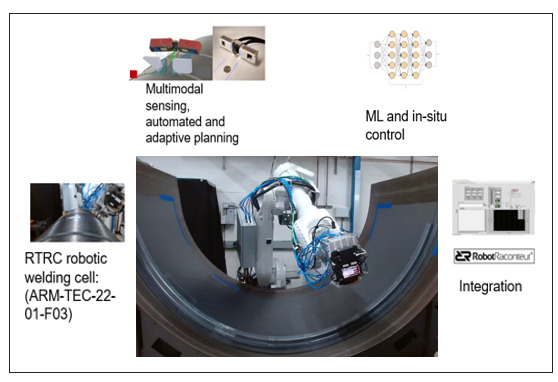
The Demonstration of Thermoplastic Composite (TPC) Rapid Welding at Scale Project built on the outputs and learnings from the prior ARM Institute project to advance the technology with the demonstration use case using a full product-scale aircraft nacelle fan cowl part. This further demonstration of viability set a key foundation for transition to industry use. The project team matured and implemented multi-modal sensing, automated planning, and in-situ control for weld quality and efficiency, demonstrating rapid TPC welding at scale. RTX Collins Aerospace, one of the leading aircraft engine nacelle suppliers, supported and guided this pivotal demonstration.
This project was the third iteration of advancements in this technology through ARM Institute-funded projects. The first project addressed induction welding, the second project centered on improving upon induction welding, this project advanced CUW at scale. It centered on addressing two ARM Institute Special Topic Areas (STAs): (1) multi-modal inputs for AI robotics in manufacturing, and (2) rapid re-tasking and robot agility.
Technical Approach
The goal of this project was to demonstrate rapid robotic TPC CUW in a production-relevant environment for a full-scale product. This project focused on maturing and integrating the multi-modal sensing, automated planning, Machine Learning (ML), and physics-informed machine learning (PIML)-based in-situ control.
The demonstration cell integrated a compact modular end effector with multi-modal sensing and learning-based in-situ control to aid weld quality control and welding efficiency. It included automated planning to minimize the up-front robot programming time in welding along multiple different complex paths.
Impact & Next Steps
CF-TPC is expected to generate approximately 25% of manufacturing cost savings as compared with current thermoset composites and or metallic structures, leading to significant cost saving for manufacturers. Joining composite components consume roughly 25% of the manufacturing cost. The Rapid CUW could contribute approximately 7.5% of manufacture cost savings, which is very significant for the large and expensive aircraft composite structures in the engine nacelle.
The successful deployment of rapid robotic CUW technology in fan cowl manufacturing is expected to spur broad adoption of CF-TPCs in other large aircraft components, such as fuselages and wing boxes, which will produce much higher cost benefits for OEM and suppliers.
The project team plans to continue to engage the business units of RTX to mature and deploy the welding automation technologies.
Results
In October 2025, RTRC successfully demonstrated robotic CUW in a representative work cell on a production scale article. The weld path was derived from scanning and automated path re-planning. The automated welding includes deployment of integrated end-effector, in-situ welding control with ML-derived algorithm, and welding pauses to control weld stack temperature.
Outputs Available to ARM Members
ARM Institute Members have exclusive access to project outputs and consortium developed intellectual property (CDIP). Outputs from this project are briefly listed below and may be accessed in the ARM Member Community:
- Multi-modal, compact sensor mechanical mounting package design documentation
- Sensor-based automated planning algorithm documentation
- Physics Informed Machine Learning (PIML) methodology for in-situ CUW control documentation
- LabView control and user interface software
- RobotRaconteur to ROS 2 bridge software
- SolidWorks Curve Exporter software
- Preliminary Gazebo sensor simulation software
- LabView control framework
- CUW system integration framework including hardware and software integration
- Demonstration videos
- Rapid continuous ultrasonic welding of TPC at full product scale with large ABB robot for use case aircraft engine nacelle fan cowl, including part scanning and automated planning
- Preliminary Gazebo-based integration simulation
Access the ARM Member Community
Join our Member Consortium
ARM Members, as well as government organizations, receive access to the outputs of ARM Institute funded projects, as well as more detailed reports and assets. ARM Members can dive deeper into projects, access outputs, and connect virtually with the project team on the ARM Member Community. Email [email protected] for assistance using the Community.
In addition to project outputs, by becoming a member of the ARM Institute’s 470+ member organization consortium, you also gain access to exclusive networking, member events, project funding opportunities, and more. As an ARM Institute Member, you’ll work across industry, government, and academia to strengthen US manufacturing through innovations in robotics, artificial intelligence (AI), and workforce development. Explore membership here to get started.
Join our consortium
ABOUT THE ARM INSTITUTE
The ARM (Advanced Robotics for Manufacturing) Institute is a Manufacturing Innovation Institute (MII) funded by the Office of the Secretary of Defense under Agreement Number W911NF-17-3-0004 and is part of the Manufacturing USA® network. The ARM Institute leverages a unique and robust consortium of 470+ members and partners across industry, academia, and government to make robotics, autonomy, and artificial intelligence more accessible to U.S. manufacturers large and small, train and empower the manufacturing workforce, strengthen our economy and global competitiveness, and elevate national security and resilience. Based in Pittsburgh, PA since 2017, the ARM Institute is leading the way to a future where people & robots work together to respond to our nation’s greatest challenges and to produce the world’s most desired products. For more information, visit www.arminstitute.org and follow the ARM Institute on LinkedIn and X.