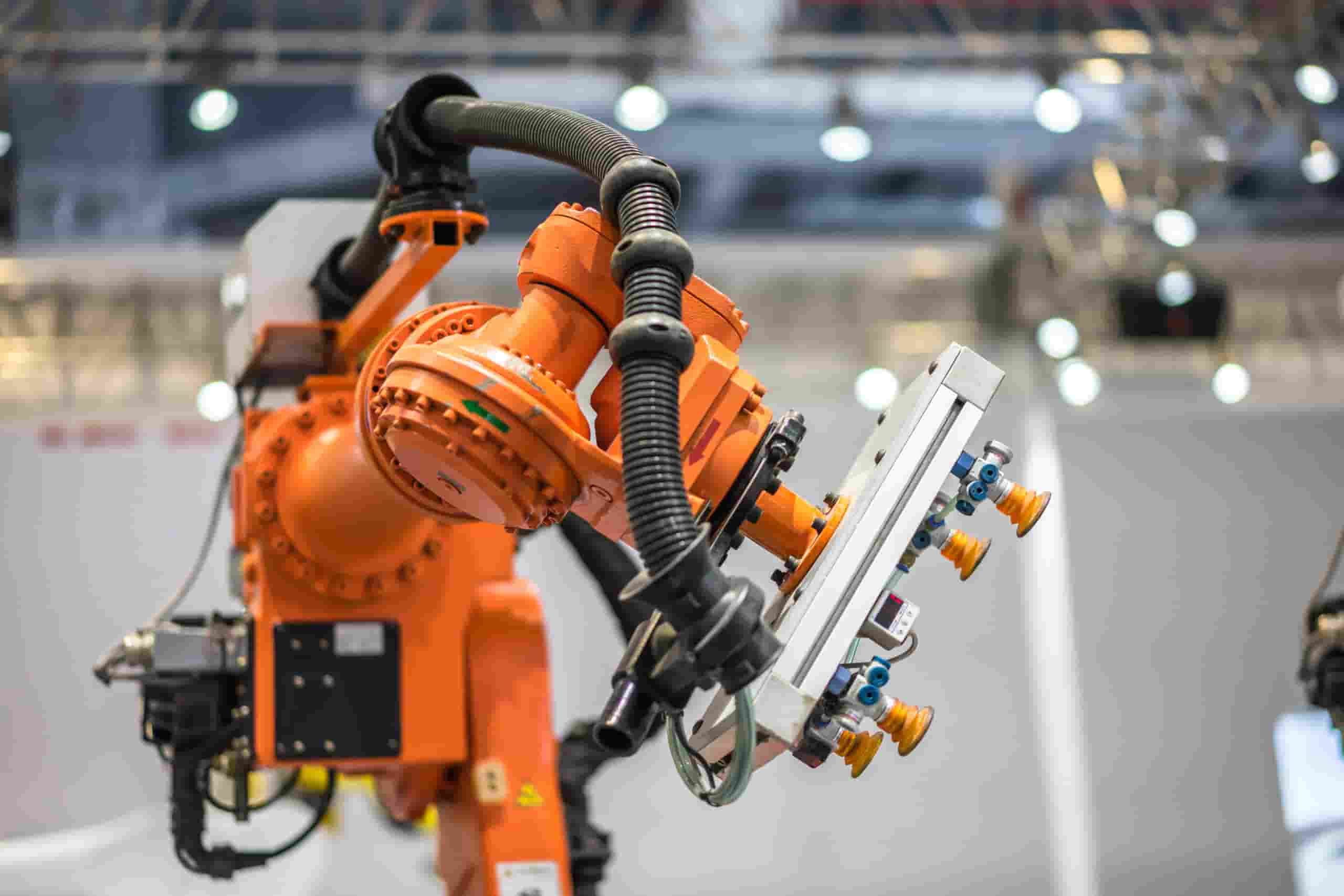
Video Credit: Zack DeZon
The Problem & Trillion Dollar Opportunity
Textile manufacturing is a trillion-dollar industry, however, its operations still largely lean on manual labor. This puts human workers in ergonomically uncomfortable conditions, exposes workers to the risk of respiratory diseases from poor air quality and injuries from fast-moving machines, and prevents the US from reshoring this growing industry. Beyond risks for consumers and workers, this also creates national security vulnerabilities with the US being unable to rapidly produce defense supplies created from textiles like tents, parachutes, life preservers, PPE, and others. And with imports representing more than 97% of the clothing sold in the US, we also lose out on significant economic opportunities.
The use of robotics sewing automation and AI would lead to safer working conditions, create new opportunities for workers to take on meaningful roles working alongside robotics rather than completing manual labor, and enable the US to finally re-shore this critical industry.
The ARM Institute & Our Expert Collaborators in Automated Robotic Sewing
The ARM Institute has funded several projects in this area, from manufacturing PPE masks in a shipping container that can be deployed at the point-of-need to sewing pockets in military uniforms. These efforts helped advance robotic sewing automation through project teams that otherwise would have stayed conceptual without that needed collaboration.
In this piece, we caught up with ARM Members Jon Zornow from Sewbo and Gokul Sathya from Siemens, who have continued their work that started as an ARM Institute project to transform their developed automated robotics sewing technology from a validated prototype into a robust, industrial solution for real-world apparel manufacturing environments.
“ARM Institute funding was instrumental in bringing together the right partners around a high-value apparel manufacturing use case. As Principal Investigator, this allowed the team to de-risk the technology, align development with real industry needs, and leverage the broader ARM Institute consortium to accelerate the transition from early-stage concept to production-ready capability.” – Siemens
“The road from a promising idea to an industrially-reliable process is too risky for margin-conscious factories and too long for conventional venture capitalists. The ARM Institute’s support allowed us to fully de-risk the technology for commercial applications, bringing it to a maturity level where it’s an attractive investment for further development.” – Sewbo
Read on to learn more about their work:
Hear from Our Project Team
How have you kept the momentum moving after your ARM Institute-funded project? What advancements have happened since the ARM Institute funding?
The automated robotic sewing technology developed through this ARM Institute-funded project has continued to advance and mature, ultimately reaching higher Technology Readiness Levels (TRL 8 and 9) through the NIST-funded RACER project, during which we built a containerized microfactory for mask manufacturing. A key part of this progress involved upgrading the software stack to run on industrial-grade hardware, including programmable logic controllers (PLCs), industrial PCs (IPCs). Collectively, these efforts transformed the system from a validated prototype into a robust, industrial solution for real-world apparel manufacturing environments.
How did this robotic sewing automation project team come together initially? How were your connections made?
The project team initially came together in 2019 in response to a Project Call from the ARM Institute. Both Sewbo and Siemens were early members of the ARM Institute, and Siemens reached out to Sewbo along with other collaborators, including Bluewater Defense, to explore automation of selected assembly operations for military trousers. The initial effort focused on reducing technical risk and validating the technology in a two-dimensional sewing application. Building on this success, the team went on to pursue several follow-on projects, including Built by Bot: Custom Mask Manufacturing, Bot Couture, and Robotic 3D sewing with commercial end user Levi’s, which focused on automating specific steps in jeans manufacturing.
Can you tell us about your vision for building your first full-scale assembly line?
With this project, we reached an exciting milestone – having developed and demonstrated the processes needed to perform half of the labor that goes into a pair of jeans, and successfully integrated with an existing assembly line to hand-off for finishing. Sewbo’s vision is to build the full-scale automated assembly line and deploy it with a partner factory’s assembly line. Siemens’ role is to serve as the technology provider, enabling that vision with the industrial automation technologies needed for scalable, production-ready deployment. We also see Physical AI as a major opportunity in this space, enabling smarter, more adaptive systems for handling the complexities of textile manufacturing.
Let’s talk about what challenges were addressed both by the project and the follow-on work you’ve pursued.

Although we’ve been able to perform a wide range of demonstrations at the lab scale, long-term success requires industrial-levels of consistency and reliability. This project was our first time integrating with an existing assembly line, where the products of our workcell were fed into existing downstream processes, an important stress-test for our deployment plans. Follow-on projects have addressed machine reliability, adding in sensors and assistive tools that allow systems to operate continuously with minimal supervision.
From a technical perspective, the project and the follow-on efforts addressed three major challenges in textile manufacturing automation.
First, the project enabled robotic execution of the most labor-intensive and complex seams that define a garment’s three-dimensional shape. Operations such as side seams and front and back rises determine the final fit and structure of jeans and have traditionally relied on skilled manual labor due to the complexity of fabric behavior and required sewing maneuvers. The project demonstrated a robotic system capable of reliably handling, aligning, and sewing these seams, making more than 50% of jeans assembly operations addressable through automation.
Second, it introduced closed-loop sewing to ensure consistent quality at production scale. Unlike other automated approaches that assume perfect setup, our system continuously monitored the fabric position during sewing with vision sensors and corrected the seam path in real time. This capability was essential for maintaining seam tolerances, reducing defects, and delivering repeatable quality where material variation is unavoidable.
Finally, in the follow-on work, the system was extended to support tangential sewing for curvilinear seams for multi-needle sewing machines. Achieving these seams requires the fabric to move perpendicular to the sewing needle axis, requiring the robot holding the fabric to dynamically adjust its velocity and acceleration in correspondence to the seam. That coordination is performed during runtime using information from the garment’s digital pattern, combined with the robot’s kinematic constraints, enabling curvilinear seams. This capability significantly expands the range of seams that can be automated by robots, supporting scalable deployment in real manufacturing environments.
What’s next for your platform?
Sewbo is leading the commercialization discussions and engagement with potential partners as the platform moves towards factory floor deployment. Sewbo has been making plans with a partner factory in Los Angeles and are starting to fundraise to build out this system. Siemens remains a key technology partner for software and hardware in supporting those efforts.
To learn how you can use this developed technology, contact Sewbo.
To explore consortium-developed intellectual property that was created via this project and others, join our member consortium and learn more on the ARM Member Community.
Build the Robotics & Physical AI Technologies Needed to Secure US Manufacturing
Imagine what ideas you can take from concept to impact when your work is strengthened by a 500 member organization consortium and thousands of individual subject matter experts. When you join the ARM Institute Member Consortium, you’re getting access to the nation’s only robotics and AI consortium dedicated to advancing US manufacturing. ARM Members:
- Collaborate on ARM Institute-funded projects that bridge gaps between start-ups, large organizations, end-users, and others to catalyze critically needed innovations both for the Department of War and commercial manufacturers
- Participate in member-exclusive events, webinars, workshops, and summits, including our Annual ARM Member Meeting (our largest networking event of the year). Our 2026 Member Meeting will mark our 10th Annual Member Meeting and will take place Nov. 17-19 in Pittsburgh, PA.
- Access our member-exclusive digital community, giving ARM Members access to project outputs, consortium developed intellectual property (CDIP), a database of Member collaborators, and more
- Drive our strategy and contribute to national programs that address areas of need in US manufacturing, including RoboticsCareer.org and others
Join our consortium
ABOUT THE ARM INSTITUTE
The ARM (Advanced Robotics for Manufacturing) Institute is a Manufacturing Innovation Institute (MII) funded by the Office of the Secretary of War under Agreement Number W911NF-17-3-0004 and is part of the Manufacturing USA® network. The ARM Institute leverages a unique and robust consortium of nearly 500 member organizations and partners across industry, academia, and government to make robotics, autonomy, and artificial intelligence more accessible to U.S. manufacturers large and small, train and empower the manufacturing workforce, strengthen our economy and global competitiveness, and elevate national security and resilience. Based in Pittsburgh, PA since 2017, the ARM Institute’s mission is to assert the US as the leading nation in manufacturing output through the adoption of robotics and AI. For more information, visit www.arminstitute.org and follow the ARM Institute on LinkedIn and X.