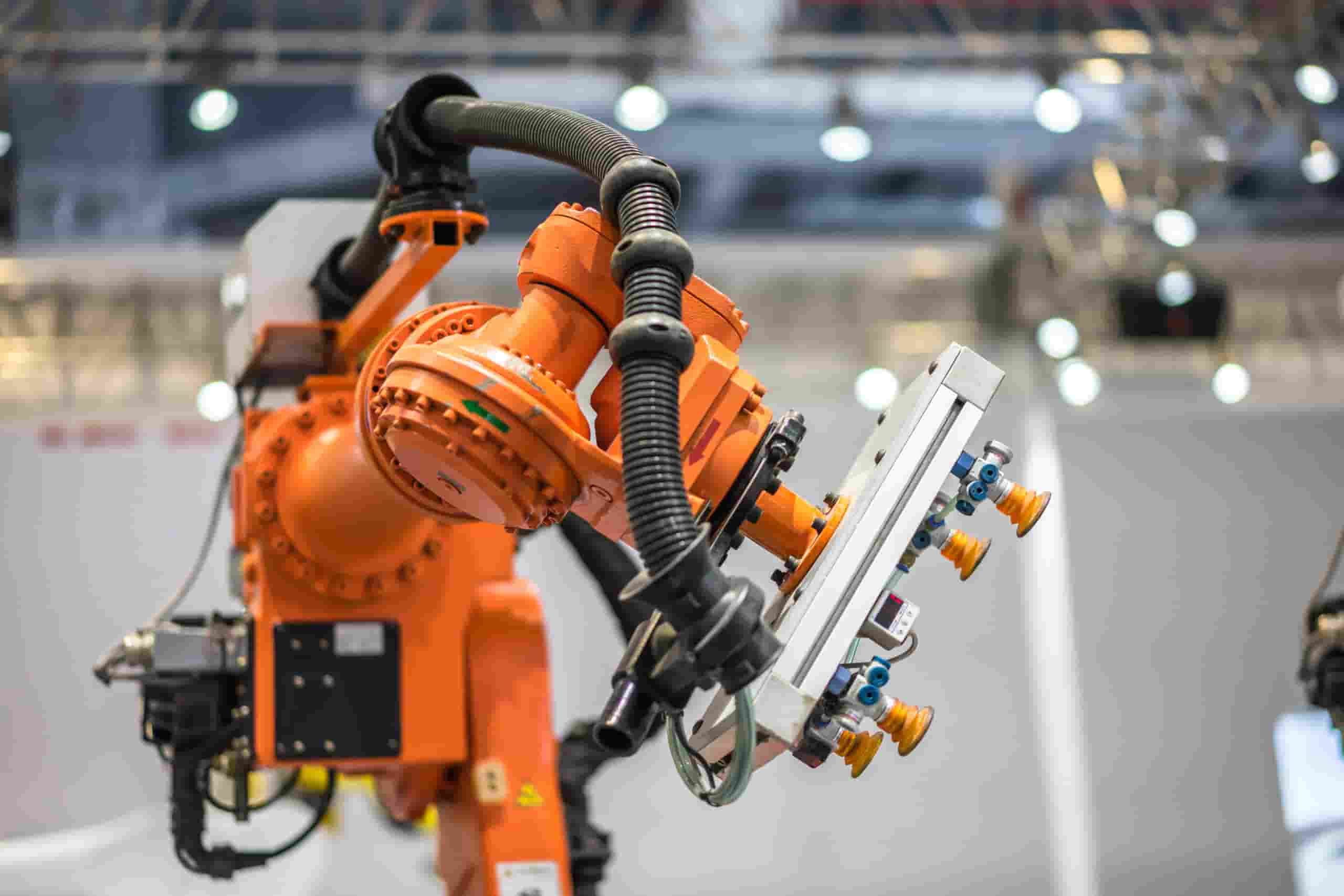

ARM Institute Project Calls identify and fund essential robotics and AI solutions to grow US manufacturing output. By spurring connections across non-traditional collaborators, the ARM Institute drives innovative solutions for the Defense and Organic Industrial Bases.
December 16, 2025 – The ARM (Advanced Robotics for Manufacturing) Institute is proud to announce the project selections from the institute’s 25-01 Core Technology Project Call issued earlier this year. This Technology Project Call centered on strengthening US manufacturing by addressing the following Special Topic Areas:
- Multi-Modal Inputs for AI Robotics in Manufacturing
- Rapid Re-Tasking and Robot Agility
- Multi-Robot, Multi-Human Collaboration
- Adaptive Real-Time Path Planning and Control
In addition to these Special Topic Areas, the ARM Institute, in collaboration with the institute Technical Advisory Committee (TAC), government partners, and other consortium experts, outlined the following manufacturing areas of interest that project teams were encouraged to leverage as example use cases: (1) metal re-casting and forging, (2) manufacturing of hypersonics, (3) manufacturing of energetics, (4) manufacturing of garments and other textile goods, and (4) robotic inspection in confined spaces.
The ARM Institute is the nation’s leading robotics and artificial intelligence (AI) Manufacturing Innovation Institute. ARM Institute projects bridge the gaps between industry, government, and academia to spur impactful innovations that strengthen U.S. manufacturing. By releasing Project Calls to the ARM Institute’s 450+ member organization consortium, the ARM Institute connects groups that otherwise would not be able to collaborate.
“These projects address a broad spectrum of challenges limiting both defense and commercial manufacturing,” said Cara Cranston, Director of Technology Programs, “We look forward to working with these project teams to translate this funding into tangible impact on US manufacturing.”
The ARM Institute plans to award around $2M in project funding, for a total contribution of approximately $4M across the four projects. Since its inception in 2017, the ARM Institute has catalyzed hundreds of robotics technology and workforce development projects.
The ARM Institute has managed a record number of Project Calls over the 2025 calendar year. This level of activity demonstrates the key role the institute and its consortium play in advancing US manufacturing through robotics and AI technology.
Learn more about each selected project below:
Dimensional Verification of Aircraft Components using an Adaptive Robotic Inspection System with a Digital Twin
Project Team: Siemens (Principal Investigator), Gray Matter Robotics, and Northrop Grumman
Description: A critical limitation in current aerospace and defense manufacturing is the lack of integration between traditional automated metrology systems and virtual commissioning, particularly in high-mix part production environments. Frequent reprogramming to inspect varied part geometries creates bottlenecks, pushing companies toward manual, error-prone, and costly methods. This Project Team will work to address this gap through a robotic inspection system integrated with a digital twin tool for the dimensional verification of aircraft components in a high-mix inspection line, where the work is currently predominantly done manually. By addressing the integration gap between virtual commissioning and metrology, this project will enhance manufacturing agility, improve product quality, and strengthen competitiveness in both defense and commercial sectors.
Adaptive Guarding for Intelligent Safety (AEGIS): Dynamic, Real-Time Risk Mitigation
Project Team: Boeing (Principal Investigator), Spirit Aerospace, and Sensory Robotics
Description: Traditional industrial robotic work cells impose rigid safety measures that limit flexibility, while current collaborative robots (cobots) integrated with Autonomous Guided Vehicles (AGVs) face challenges in dynamic environments due to inadequate safety systems that do not monitor real-time movements. This project team will work to address this gap by developing a modular, platform-agnostic dynamic safety system for mobile cobots integrated with Autonomous Mobile Robots (AMRs) that dynamically adjusts safety zones based on real-time location, velocity, and trajectory.
Agile Robotic Deep In-Hole Scanning
Project Team: ARIS Technology (Principal Investigator), G.C. Laser Systems, and FANUC
Description: Non-contact 3D scanning is a powerful tool for 3D inspection. When it is integrated into a robotic system as an End-of-Arm-Tool (EOAT), it can capture 3D data in mesh or point cloud format without contacting the surface. However, when dealing with convexity, numerous problems arise, including the inability to measure as deep as the inner diameter. Commonly, both the scanner and the robot arm are too large to reach convex regions. This project team will work to address this gap through the development of an end-to-end process from robotic surface 3D scanning, localization, agile in-hole 3D scanning, and sensor data fusion.
FOD Finder – Foreign Object Debris Fixtureless Inspection and Navigation in Dynamic Environments Robot
Project Team: ThoughtForge Inc. (Principal Investigator), Northrop Grumman Corporation, Siemens Corporation, and Airbus
Description: Foreign Object Damage (FOD) is commonly defined as damage to any army vehicle, equipment or property because of object alien to the vehicle or equipment damaged. FOD detection within aerospace and defense manufacturing requires inspecting deep airframe structures and ducts with complex geometries from various angles. These processes usually involve either a human worker squeezing and inserting themself into an airframe or an air duct for inspections. Existing Non-destructive testing (NDT) techniques like ultrasound and x-ray methods struggle with layered composite materials used in modern aircraft structures. As a result, FOD detection continues to be an especially challenging task with significant room for improvements. This project team aims to address this gap through the development of a robotic system enabled with real-time motion planning capability that would allow navigation of airframe structures for fixtureless inspection of FOD.
26-01 TECHNOLOGY PROJECT CALL
The ARM Institute also recently issued the final version of its 26-01 Core Technolgy Project Call, which centers on high-priority, defense application areas. Dual-use technology that also benefits the broader U.S. manufacturing sector is preferred, but the focus of this project call is primarily on defense applications. Concept papers are due on February 4 in the ARM Member Community. Learn more here.
ABOUT THE ARM INSTITUTE
The ARM (Advanced Robotics for Manufacturing) Institute is a Manufacturing Innovation Institute (MII) funded by the Office of the Secretary of Defense under Agreement Number W911NF-17-3-0004 and is part of the Manufacturing USA® network. The ARM Institute leverages a unique and robust consortium of 470+ members and partners across industry, academia, and government to make robotics, autonomy, and artificial intelligence more accessible to U.S. manufacturers large and small, train and empower the manufacturing workforce, strengthen our economy and global competitiveness, and elevate national security and resilience. Based in Pittsburgh, PA since 2017, the ARM Institute is leading the way to a future where people & robots work together to respond to our nation’s greatest challenges and to produce the world’s most desired products. For more information, visit www.arminstitute.org and follow the ARM Institute on LinkedIn and X.